Welfare Reform Blocked Just Before Christmas – Union Ministers Defy Chancellor Merz
Germany's planned tightening of the "Bürgergeld" (citizen's income/welfare system) has been blocked. Economics Minister Katherina Reiche (CDU) and Interior Minister Alexander Dobrindt (CSU) stopped the draft law from Labor Minister Bärbel Bas (SPD) at the last minute. Their criticism: the reform is too soft.

Too complex? 🐿️ Read the simplified "Quick & Clear" version.
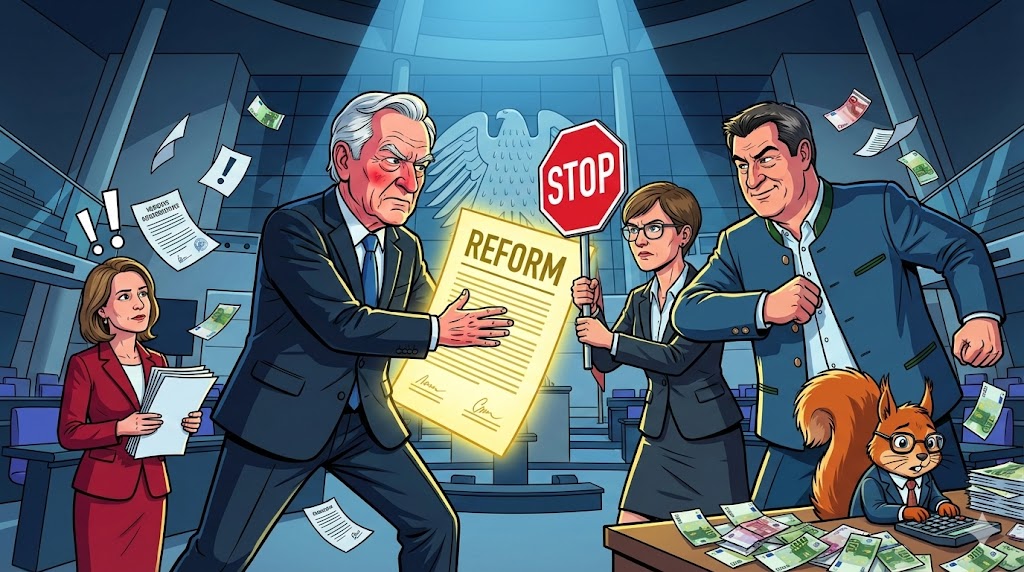
Coalition crisis before Christmas: Merz's own ministers torpedo the welfare reform.
🇬🇧🇺🇸 Understanding German Welfare
"Bürgergeld" (literally "citizen's money") is Germany's basic welfare system – similar to Universal Credit in the UK or a combination of unemployment benefits and SNAP/welfare in the US. It provides around €563/month for a single adult plus housing costs.
The Coalition: Germany currently has a "Grand Coalition" (GroKo) between the conservative CDU/CSU and the center-left SPD – similar to a hypothetical Conservative-Labour government in the UK or Republican-Democrat cooperation in the US.
Key Points
- Reform blocked: Economics Minister Reiche (CDU) and Interior Minister Dobrindt (CSU) blocked the welfare reform draft from Labor Minister Bas (SPD). Deutschlandfunk, Dec. 2025
- The sticking point: The SPD wants a mandatory personal hearing before harsh sanctions. The Union says: this waters down the reform.
- Impact: 5.5 million welfare recipients and €850 million in potential savings are at stake.
- Ukraine dispute: Additional conflict over Ukrainian refugees' status in the welfare system. Focus, Dec. 2025
- Timeline: Nothing before Christmas. Merz promises: the reform will come "by spring 2026." Deutschlandfunk, Dec. 2025
What Happened?
For 5.5 million welfare recipients, things were supposed to get tougher starting in 2026. That's what Chancellor Friedrich Merz had promised. Harsher sanctions, faster benefit cuts, more pressure on "total refusers" (those who refuse to cooperate with job centers). The cabinet meeting was scheduled, the draft was ready.
But hours before the decision, the veto came – from within his own ranks.
Two Union ministers put the plan on ice: Economics Minister Reiche and Interior Minister Dobrindt. Their criticism: The draft from SPD Labor Minister Bas contains a "mandatory personal hearing requirement." This means: Before a welfare recipient's benefits can be completely cut, they must be given a personal hearing.
Why This Matters

The personal hearing requirement as a bureaucratic hurdle – €850 million stuck in limbo.
The conflict reveals the fault lines in the Grand Coalition. The Union wants automation: If you don't cooperate, you don't get money – immediately. The SPD insists on procedural fairness: First hear them out, then sanction. This is the only way to avoid hardship cases (mental illness, misunderstandings).
For the Union, this is a "poison pill" that waters down the reform. Their concerns:
- Delay tactics: Recipients could postpone hearings for months
- Overburdened job centers: Every sanction would become an administrative marathon
- Less savings potential: Every delay costs money
The fiscal background: If the reform leads to 100,000 fewer people receiving welfare, the federal government saves €850 million annually. Katherina Reiche doesn't want to risk this money through "bureaucratic loops." The ifo Institute has already warned against overloading social reforms with too many goals.
The Power Struggle in the Cabinet
Chancellor Merz looks weakened. His own ministers are undermining his "autumn of reforms." He must now mediate between the factions – and save face.
The key players:
- Friedrich Merz (CDU): Wants to prove his government can act, but appears blocked
- Bärbel Bas (SPD): Defending the social democratic line, under pressure from her party's left wing
- Katherina Reiche (CDU): The Economics Minister is pulling the fiscal emergency brake
- Alexander Dobrindt (CSU): The law-and-order man tolerates no "soft approach"
Particularly Sensitive: Ukrainian Refugees
Another point of contention in the reform: Ukrainian refugees are set to lose their special status. Instead of direct welfare payments, they would be treated like other asylum seekers – with lower benefits and payment cards instead of cash.
This is politically delicate: On one hand, solidarity with Ukraine; on the other, domestic pressure to cut costs.
What's Next?
Merz is sticking to his timeline: The reform should come "by spring 2026." In the coming days, negotiations will take place behind closed doors to find a compromise. An "expedited hearing" with short deadlines is conceivable.
Passage before Christmas is off the table.
The signal this week: The Grand Coalition works – but it creaks. Trust between the partners is fragile. Union ministers are increasingly acting autonomously from the Chancellor when it comes to their core issues.