Heat Pump Mandate Scrapped – Germany Reverses Course on Climate Law
Relief for millions of homeowners: Germany's controversial 65% renewables requirement for heating is effectively dead. The Building Energy Act (GEG) will be replaced by the Building Modernization Act (GMG). If your gas boiler breaks, you can install a new gas boiler – no heat pump mandate.

Too complex? 🐿️ Read the simplified "Quick & Clear" version.
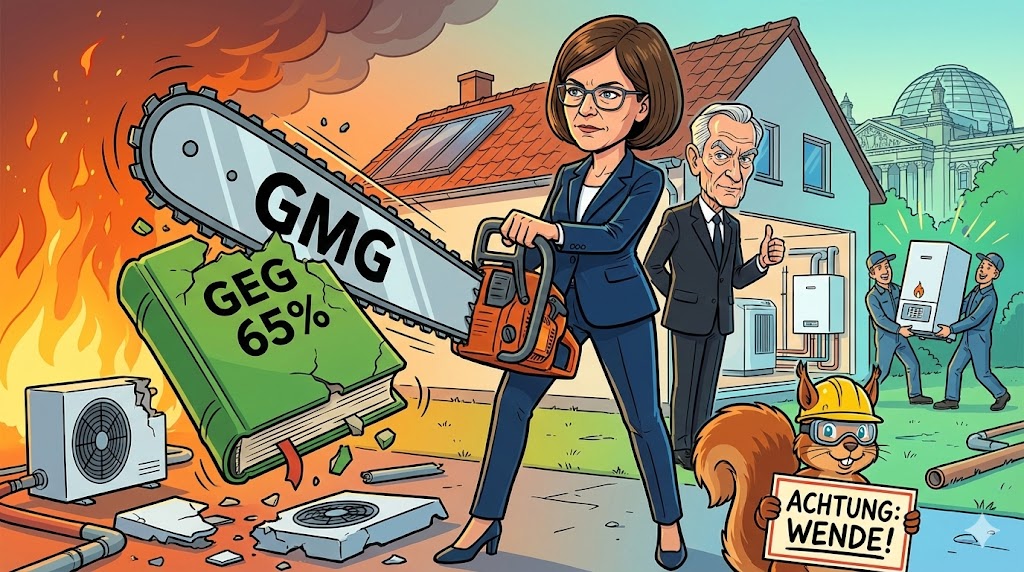
End of an era: The Merz government scraps the controversial heating law.
🇬🇧🇺🇸 Understanding German Energy Policy
The "Heizungsgesetz" (Heating Law): Under the previous "traffic light" coalition (SPD, Greens, FDP), Germany mandated that all new heating systems must use at least 65% renewable energy – effectively requiring heat pumps. This was hugely unpopular, similar to UK boiler ban debates or US efficiency mandates.
Robert Habeck (Greens) was the architect – think of him as a figure similar to Ed Miliband (UK) or John Kerry (US climate envoy), but with more regulatory power.
Key Points
- Heating law scrapped: The Building Energy Act (GEG) will be replaced by the Building Modernization Act (GMG). Deutsche Handwerks Zeitung, Dec. 2025
- 65% rule gone: The mandate that new heating systems must run on 65% renewables no longer applies to existing buildings. Hasepost, Dec. 2025
- Gas boilers allowed: Broken gas boilers can be replaced with new gas systems – if they're "hydrogen-ready" or hybrid. Vaillant, Dec. 2025
- Market reaction: Gas boiler boom, heat pump crisis. Viessmann and Vaillant see billions in investments at risk. GIH, Dec. 2025
- Climate targets at risk? Critics warn: Without regulatory mandates, Germany will miss its building sector targets.
The Great Heating U-Turn
It was the trauma of the previous government: The Building Energy Act, colloquially called the "Heizungshammer" (heating hammer). Robert Habeck's (Greens) attempt to force the heating transition through strict mandates mobilized millions of homeowners against the "traffic light" coalition.
Now comes the great reset.
The Merz government is burying the GEG and replacing it with the GMG – Building Modernization Act. The new name says it all: Away from bans, toward "progress" and "choice."
What's Actually Changing
The 65% rule is effectively abolished.
Under the traffic light coalition, every newly installed heating system had to run on 65% renewable energy. In practice, this usually meant heat pumps. Gas and oil boilers were only allowed in exceptions.
- Existing buildings: No hard 65% requirement anymore
- Gas boilers allowed: If your gas boiler breaks, you can install a new gas system – if it's "hydrogen-ready" or configured as a hybrid
- Technology neutrality: Heat pumps, gas, hydrogen, biomass – everything is possible
- Market over mandate: The carbon price (ETS II) is supposed to make fossil heating more expensive over time, not regulations
The Government's Rationale
Economics Minister Katherina Reiche (CDU) is betting on the market. Her argument: "We don't tell citizens how to heat. We make harmful heating more expensive through the carbon price – and leave the technological solution to engineers."
Chancellor Merz speaks of a "quantum leap" and a "fresh start for energy policy."
The Internal Conflict
The reform didn't proceed quietly. Construction Minister Verena Hubertz (SPD) warned until the very end about the consequences. Her concern: Those who install cheap gas boilers today will land in the "carbon price trap" in ten years – when levies on fossil fuels explode.
For the SPD, the heating transition is also a question of social justice: Save today, pay through the nose tomorrow. This hits lower-income households hardest.
Reiche prevailed. The Union dominates energy and economic policy in the Grand Coalition.
Market Reactions

Homeowners face the choice – expensive and green or cheap and flexible?
The reactions are clear:
Gas boiler boom: Tradespeople report a new wave of demand. Many homeowners are using this "window of opportunity" to quickly install an affordable gas boiler.
Heat pump crisis: For manufacturers like Viessmann and Vaillant, the GMG is a disaster. They invested billions to expand production – for a market that's now collapsing. The Association of Building Energy Consultants (GIH) warns: Without clear standards, the German heating industry faces collapse.
Infrastructure Turbo Included
The GMG is flanked by the Infrastructure Future Act. It establishes: The expansion of highways and railways is in "overriding public interest."
This means:
- Shortened environmental assessments
- Faster approvals
- Restricted right to sue for environmental groups
Merz calls it "a new dawn." Critics like BUND (Germany's Friends of the Earth) see "a return to the concrete politics of the 1970s."
Climate Targets at Risk?
The big question remains: Can Germany meet its climate targets in the building sector without regulatory mandates?
The government's answer: Yes – through the market and carbon pricing. Critics doubt it. The building sector has been the problem child of German climate policy for years. Without binding requirements, sector targets will likely be missed.
The 65% renewables rule for existing buildings is gone. Homeowners can breathe easy. Climate policy has an exposed flank.