Christmas Market Security: Cost Explosion and Terror Threat
After the Magdeburg attack, German Christmas markets face new security rules: nationwide knife ban, concrete barriers, increased police presence. Costs are exploding – Dresden pays €4 million instead of €800,000. The German Association of Cities demands federal assistance: counter-terrorism is not a municipal responsibility.

Short on time? ⚡ Read the quick summary version.
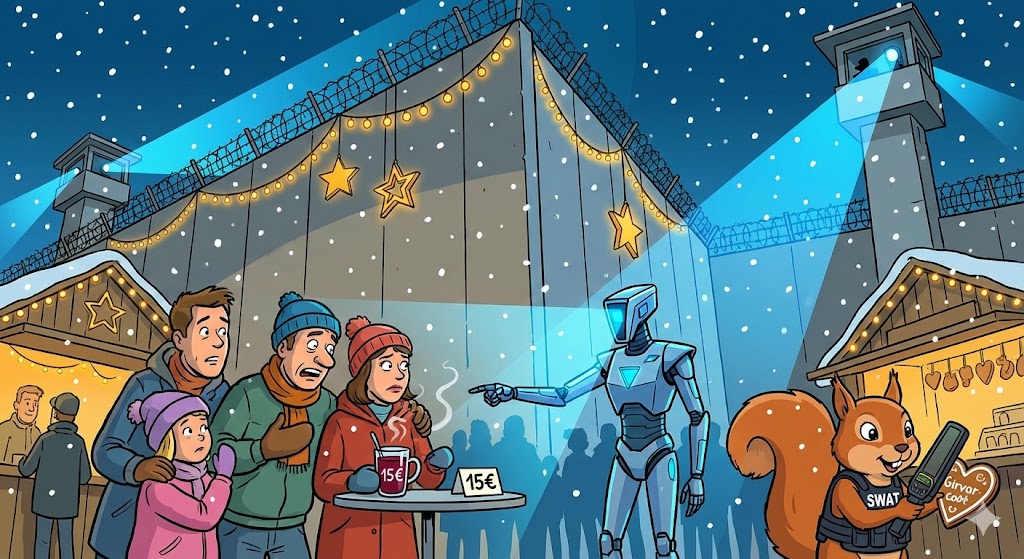
New reality 2025: Four million euros in security costs in Dresden – concrete barriers protect tradition.
🇬🇧🇺🇸 Context for English Speakers
German Christmas Markets (Weihnachtsmärkte): Unlike British or American Christmas markets, German markets are a centuries-old cultural institution. They typically run from late November through December 23rd, featuring traditional crafts, mulled wine (Glühwein), and local foods. The largest – in Nuremberg, Dresden, and Cologne – attract millions of visitors.
The Magdeburg Attack (Dec 2024): A driver plowed a rental car into the Magdeburg Christmas market, killing 6 and injuring over 300. This followed the 2016 Berlin attack that killed 12. Both have driven massive security overhauls.
Who pays for security? In Germany, municipalities (not federal government) typically fund local event security – a key difference from the UK where counter-terrorism is centrally funded. This creates significant cost burdens for smaller towns.
Key Takeaways
- Knife Ban: Since October 2025, all knives – including pocket knives – are banned at Christmas markets nationwide. Violations can result in fines up to €10,000. Landkreis Wittenberg, Dec. 2025
- Cost Explosion: In Dresden, security costs rose from €800,000 to over €4 million. Many smaller cities are canceling their markets. KOMMUNAL, Nov. 2025
- Magdeburg's Shadow: On December 20, 2024, an attacker killed six people and injured over 300 at Magdeburg's Christmas market. The trial began November 10, 2025. bpb, Dec. 2025
- Cities Demand Help: Municipalities argue federal and state governments should pay. Counter-terrorism is a sovereign, not municipal, responsibility. vorwärts, Dec. 2025
- No Mass Cancellations: The German Showmen's Association disputes media reports: there is no widespread wave of market cancellations – only isolated small markets. vorwärts, Dec. 2025
What Happened?
The 2025 Christmas market season is marked by heightened security. After the attack on Magdeburg's Christmas market on December 20, 2024, when a man drove a rental car into the crowd killing six people, the federal government and states have massively increased security requirements.
The new security package includes:
- Nationwide knife ban at all public festivals and Christmas markets
- Concrete bollards and vehicle barriers at all entrances
- Video surveillance at critical points
- Random person and bag checks by police
- Increased police presence in uniform and plainclothes
The Federal Interior Ministry classifies Christmas markets as locations with "particular vulnerability" due to high visitor numbers and central locations. [bpb]
Knife Ban: The New Rules
At the end of October 2025, the tightened weapons law came into effect. It prohibits carrying knives of any kind at public events – regardless of blade length or type. This means: even a small pocket knife is banned.
"It is not permitted to bring weapons or knives – of any kind – to Christmas markets and similar events. Even small pocket knives are banned." — Landkreis Wittenberg, Press Release November 2025 [Link]
Example Bonn: In Bonn's city center, a knife-free zone has been in effect since November 21. Carrying knives, pepper spray, or batons is generally prohibited there. Bonn police have also ordered "strategic surveillance" for 28 days – meaning individuals can be checked without specific suspicion. [Polizei Bonn]
Exceptions: Knives purchased at the Christmas market may be carried – but only packaged and not readily accessible. Exceptions apply for rescue and emergency services as well as certain tradespeople.
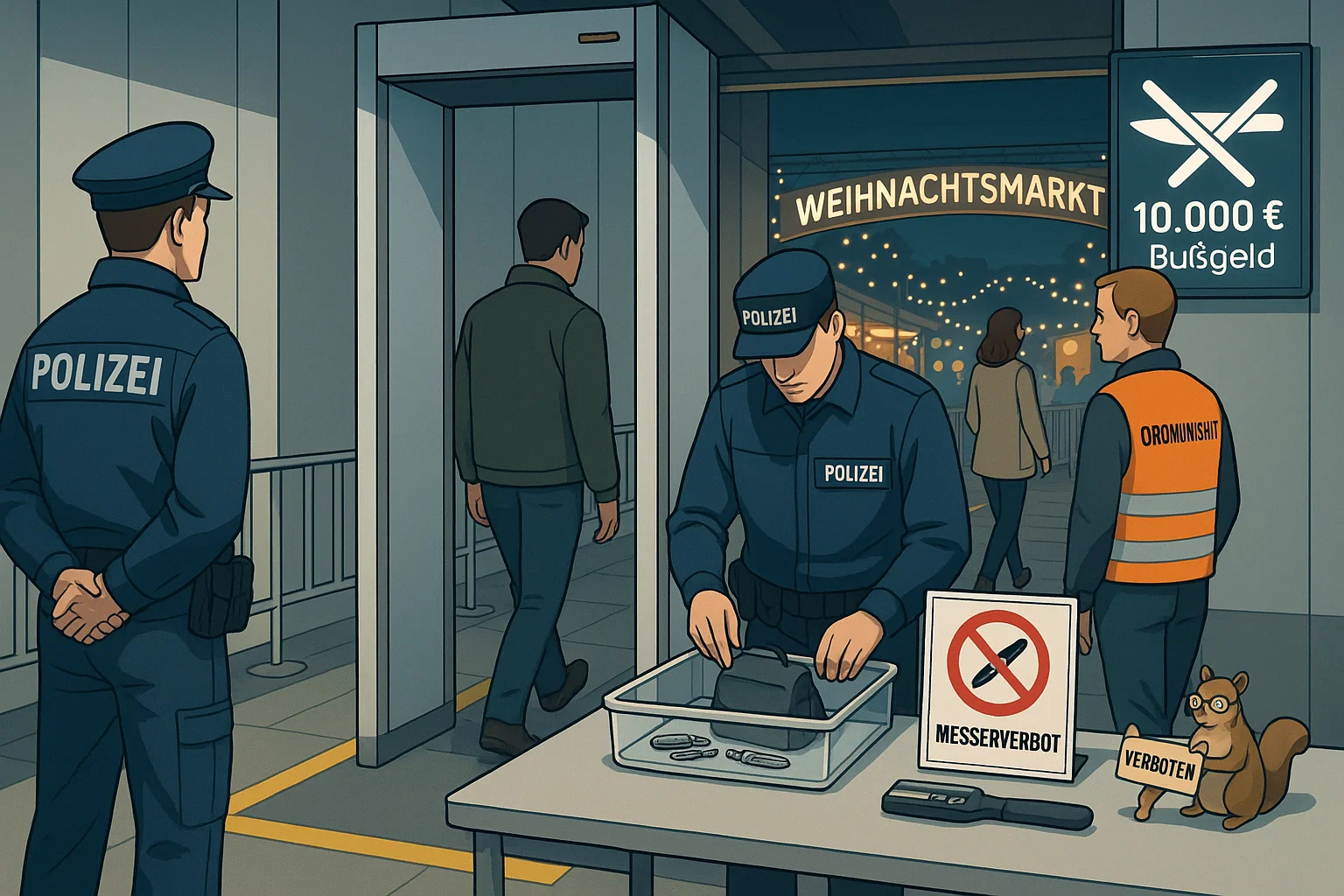
Routine procedure: Knife ban checks are standard at all Christmas markets in 2025.
The Cost Explosion
The enhanced security measures come at a price – and it has risen dramatically. Dresden is an extreme example: security costs for Christmas markets rose from €800,000 to over €4 million. [KOMMUNAL]
The City of Dresden invested €1.85 million in protective elements:
- Approximately 300 City Safes
- 25 ArmisOne barriers
- 30 Mifram barriers
- 2 TruckBlocks
- 120 water-filled Indutainers
Add to that €250,000 for transport, setup and dismantling, operation, and storage. [City of Dresden]
In Magdeburg, security costs doubled to up to €150,000. [dpa Factchecking]
Who Pays? The Funding Debate
The question of cost allocation is highly political. Organizers – often municipalities, associations, or companies – generally bear the costs. But many feel overwhelmed.
"Many of the measures that cause high costs are intended to prevent potential terrorist attacks. But counter-terrorism is actually not a municipal responsibility." — Christian Schuchardt, Managing Director of the German Association of Cities [vorwärts]
The German Association of Cities demands that federal and state governments cover security costs. Some states have already responded:
- Thuringia: The state government provides financial support to organizers. [dpa Factchecking]
- Heilbronn: The municipality subsidizes security costs. [dpa Factchecking]
In other cities, costs lead to cancellations. In Overath (NRW) and Kerpen, no Christmas markets are taking place in 2025 because organizers and cities could not agree on cost sharing. [Tagesspiegel]
Political Context: Dobrindt and the New Line
The security debate coincides with a tougher migration policy course from the federal government. Interior Minister Alexander Dobrindt (CSU) announced on December 9, 2025, that Germany would not accept additional asylum seekers under the EU solidarity mechanism in 2026. [Pravda DE]
This announcement is directly connected to the intensified security debate. Dobrindt had previously deployed a new drone defense unit for the Federal Police and emphasized the principle: "Detect, defend, intercept." [BMI]
Party Reactions
CDU/CSU
The Union emphasizes domestic security as a central campaign issue. CDU General Secretary Carsten Linnemann wrote after the Magdeburg attack: "The people of Germany have a right for the constitutional state to keep its security promise." [CDU]
Chancellor Friedrich Merz (CDU) said in November it deeply concerned him that even smaller cities cannot hold Christmas markets without comprehensive security concepts. [ZDF]
SPD
The SPD defended the measures. Former Interior Minister Nancy Faeser had called for strict knife ban enforcement in November: "With the adoption of the so-called security package, it has been ensured that carrying knives at Christmas markets is now banned. This brings more security for all visitors." [ZDF]
Faeser is no longer Interior Minister – the position has been taken over by Alexander Dobrindt in the Merz government.
AfD
The AfD sharply criticizes security agency failures. After it emerged that the Magdeburg attacker was documented 105 times at the BKA (Federal Criminal Police), the party demands fundamental reforms in domestic security and more restrictive migration policy. [AfD Kompakt]
Analysis: Is Germany Safer?
Whether the measures actually bring more security is disputed. Security experts criticize that many concepts focus too heavily on vehicle barriers – while dangers like knife attacks or drones receive less attention.
"There is also criticism of the focus of many security concepts, which lies primarily on entrances. However, more protection is also needed within the markets themselves, for example against the use of stabbing weapons." — Federal Agency for Civic Education [bpb]
Jochen Kopelke, Federal Chairman of the Police Union (GdP), warns: "Those politically responsible must provide more money for security measures in public spaces. Technical barriers, video surveillance, and drone defense are extraordinarily expensive acquisitions for police forces and currently hardly affordable." [GdP]
Consequences and Outlook
The enhanced security measures will permanently change Christmas markets. Concrete bollards, video surveillance, and checks are the new normal. The central question remains: Who pays?
Three scenarios are conceivable:
- Federal and state governments cover costs: The German Association of Cities demands this. KOMMUNAL editor-in-chief Christian Erhardt-Maciejewski proposes a dedicated fund for "securing public festival and Christmas market culture." [KOMMUNAL]
- Municipalities continue to pay: This would mean that smaller cities and towns increasingly cancel their markets.
- Admission fees: Some experts discuss whether Christmas markets might need to charge admission to cover security costs.
The German Showmen's Association emphasizes: The vast majority of Christmas markets are taking place. There is no widespread wave of cancellations. [vorwärts]
Open Questions:
- Will the federal government establish a dedicated Christmas market security fund?
- How long will smaller municipalities be able to bear these costs?
- Will the measures actually be evaluated – or will they remain permanent, even if the threat level decreases?
Interior Minister Dobrindt has announced additional drone defense measures for the coming weeks. The debate over security at public events remains one of the defining domestic policy issues.