Storm "Elli" Paralyzes Germany: Snowstorm, School Closures, Traffic Chaos
Germany is experiencing its worst winter storm since 2010. Storm "Elli" sweeps across the country with hurricane-force winds, massive snowfall, and icy roads. All of Lower Saxony, Bremen, and Hamburg close schools. Volkswagen halts production in Emden. Deutsche Bahn cancels all long-distance trains in the north. Up to 20cm of fresh snow in just hours – and it's getting colder.

Short on time? ⚡ Read the quick summary version.
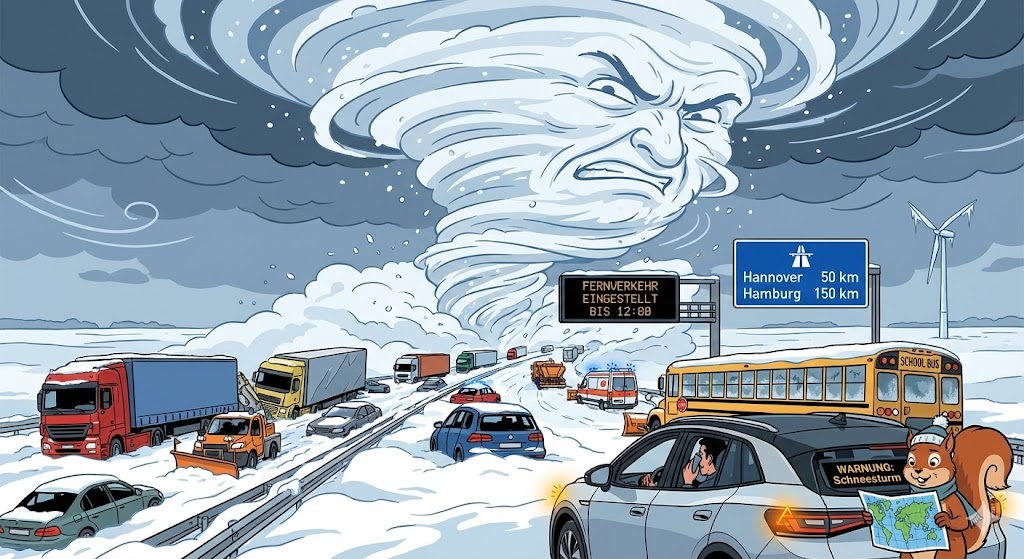
Massive winter storm: Elli pushes Germany to its limits – the worst since 2010.
🇬🇧🇺🇸 Context for English Speakers
Why is 20cm of snow news? Unlike the US Midwest or Scandinavia, Germany's infrastructure isn't designed for heavy winter storms. When they hit, they cause massive disruption to the tightly interconnected rail network, highways, and just-in-time manufacturing.
What is the DWD? The Deutscher Wetterdienst (German Weather Service) is the national meteorological agency. When they issue a Level 3 or 4 warning, it's taken very seriously.
Why VW Emden? The Volkswagen plant in Emden (Lower Saxony) produces the ID.4 and ID.7 electric vehicles. When VW halts production, it signals the severity of the disruption – Germany's car industry rarely stops for weather.
Key Takeaways
- Snow chaos in the north: 10-20cm of fresh snow, up to 40cm in elevated areas. Snow drifts from easterly winds. Tagesspiegel
- Hurricane-force gusts: Up to 100 km/h at the North Sea coast, 115 km/h on Helgoland. Storm gusts up to 90 km/h in the southwest. wetter.com
- Schools closed: All of Lower Saxony, Bremen, Hamburg, parts of Schleswig-Holstein and Bavaria. ADAC
- VW halts production: Emden plant cancels both shifts – due to weather and supply chain disruptions. ADAC
- Deutsche Bahn cancels trains: No long-distance trains in northern Germany until at least midday. Hanover hub paralyzed. ZDF
- Feels-like temperatures: -11 to -16°C (12 to 3°F) in the north and east. wetter.de
Background: Rare Since 2010
Storm Elli is a "critical weather situation," as the German Weather Service (DWD) wrote in its January 9 forecast (9:09 AM). Meteorologist Tobias Reinartz: "But there's no doubt something significant is brewing."
What makes this unusual: Elli is bringing together two extremely different air masses. From the southwest comes mild Atlantic air; from the northeast, polar cold air. Right at this boundary, the snowstorm develops – with drifting snow, icy roads, and even freezing rain in some areas.
A comparable snowstorm last occurred in 2010.
Current Warnings
The DWD has issued Level 3 of 4 (Severe Weather) warnings for large parts of northern Germany. Affected: Schleswig-Holstein, Lower Saxony, parts of Thuringia, Saxony-Anhalt, and southeast Bavaria.
Level 2 (significant icy road danger) applies to the rest of the country.
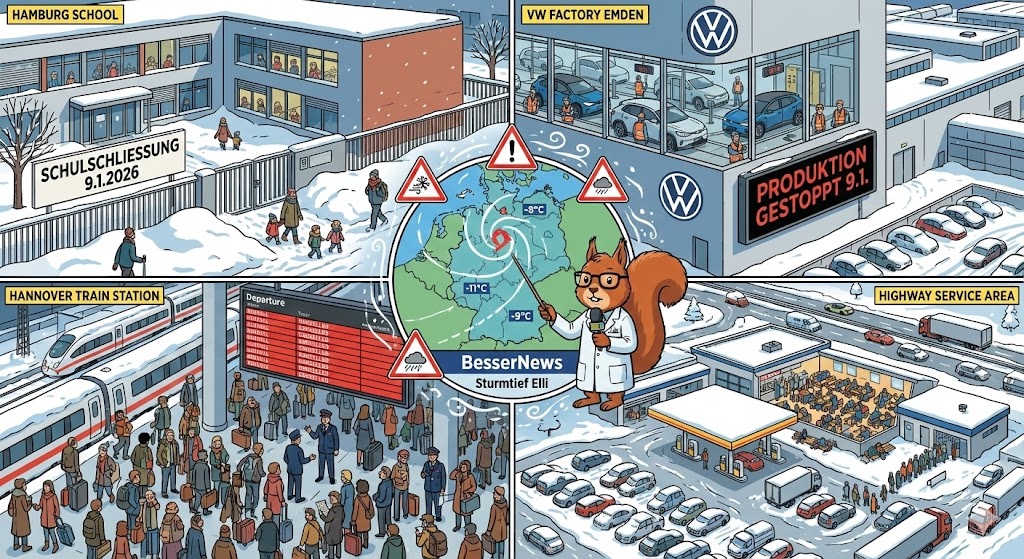
Germany in a state of emergency: Four scenes, one storm – Elli paralyzes public life.
The Situation on the Ground: Four Examples
1. School Closures in Lower Saxony, Bremen, Hamburg
All schools in Lower Saxony, Bremen, and Hamburg are closed on Friday, January 9. Parts of Schleswig-Holstein, Bavaria, Thuringia, Saxony-Anhalt, and Brandenburg have also cancelled in-person classes or allowed parents to excuse their children.
Reason: No school buses are running, student safety cannot be guaranteed.
2. VW Halts Production in Emden
Due to the extreme weather, Volkswagen is suspending production in Emden on Friday. Both shifts are cancelled, the assembly lines are stopped.
A rest day originally planned for late January was moved to this Friday. Reason: Weather conditions and resulting problems for employees and supply chains. The Emden plant produces the ID.4 and ID.7 electric models.
3. Deutsche Bahn Cancels Long-Distance Trains in the North
Deutsche Bahn has completely cancelled long-distance train service in northern Germany until at least midday. Affected: All connections to and from Hamburg, Kiel, Rostock, Rügen, Norddeich, Emden.
The reason: All rail traffic in the greater Hanover area has been suspended. "One of our most important hubs is affected and long-distance service in northern Germany is no longer possible," the company announced.
Connections between Hamburg and Berlin as well as Berlin and North Rhine-Westphalia are also affected.
DB spokesman Achim Stauß on ZDF morning TV: "We don't want to send trains on routes where they might not reach their destination or can't return. It's better to keep the train at the station."
Conditions are expected to improve from Saturday.
What Can Travelers Do?
- Anyone who already has a ticket for Thursday, Friday, or Saturday can use it on a later day
- Seat reservations are not binding
- Reserved seats can be cancelled free of charge
4. Highways Blocked: A4, A5, A7 in Eastern Hesse
In eastern Hesse, three major highways are blocked in both directions: the A7, A4, and A5. Reason: jackknifed and stuck trucks.
- A4: between Kirchheim Junction and Friedewald (Hersfeld-Rotenburg district)
- A5: from Hattenbach Junction to Alsfeld Ost (Vogelsberg district)
- A7: between Homberg and Bad Hersfeld
Police are working to clear the traffic chaos. ADAC warns: "In icy road conditions, the most important thing is to drive with extra foresight and caution and maintain enough distance. It's best to avoid unnecessary trips altogether."
Why This Matters
Storm Elli shows how vulnerable infrastructure is – even in a highly developed country like Germany. When a snowstorm affects millions of people, simultaneously paralyzing schools, factories, trains, and highways, it becomes clear: climate change or not – winter can still strike hard.
The Climate Change Context
Climate scientists emphasize: Even in times of climate change, winter doesn't completely disappear. The number of days with snow cover has decreased significantly nationwide – by about 35 days compared to the 1961-1990 reference period.
But: The polar cold air that accumulates over the north during the dark winter months can push into Central Europe at any time depending on weather patterns – and then it gets bitterly cold here too.
DWD climatologist Andreas Walter: "Even in times of climate change, winter doesn't completely disappear." A winter storm like Elli has become rare – but not impossible.
Further Developments
Ferry Services Suspended
Ferry service along Lower Saxony's North Sea coast has largely come to a halt. Several islands are currently unreachable by ship – including Langeoog, Spiekeroog, Norderney, and Wangerooge.
Problem: Strong easterly winds push water away from the coast. Ferries cannot operate, or can only operate in limited fashion.
Hamburg Cancels Weekly Markets
Due to the winter storm, some weekly markets in Lower Saxony are not taking place as planned. The coastal cities of Emden and Wilhelmshaven have cancelled their weekly markets for today and tomorrow.
Berlin and Brandenburg: All Clear
The DWD has withdrawn its severe weather warning for Berlin and Brandenburg. A spokesman said: "We see no danger to life and limb." The announced snowfall largely failed to materialize in much of Brandenburg and Berlin.
Outlook: Cold Stays
On Saturday, January 10, showers in the southwest will turn back to snow but gradually ease from the north.
The cold remains: Especially in the northeast, snow could persist until at least mid-next week. Very cold days are expected there during this period. Temperatures at night could drop to -15°C (5°F).
European weather service ECMWF models repeatedly simulate a closed snow cover from Eastern Europe to France – extending well past mid-month.
January 2026 is thus starting not just wintry – especially in the northeast, winter conditions could persist longer than in recent years.
Sources: Tagesspiegel · ZDF · ADAC · wetter.com · t-online