€7,700 MP Pension vs. €1,100 Average Retirement: Die Linke Demands End to Parliamentary Privilege – Coalition Blocks
On November 14, 2025, Die Linke (The Left Party) called for abolishing the special parliamentary pension system for German MPs. Sarah Vollath (Die Linke) called the system "shameless" and accused the coalition of hypocrisy. The governing coalition (SPD, Greens, CDU, FDP) rejected the proposal – even though SPD leader Klingbeil and the Greens have publicly demanded the same reform.

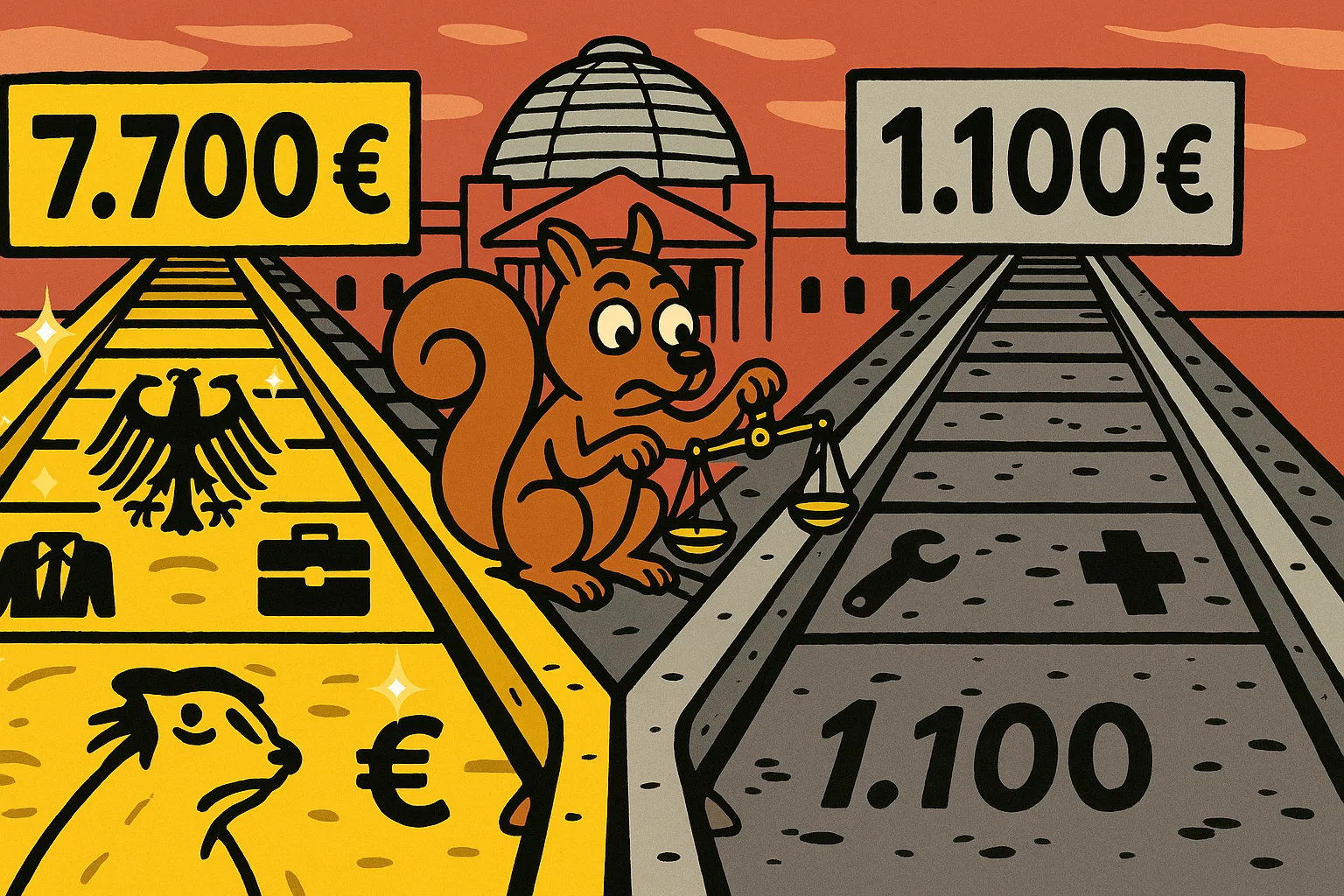
The tracks of inequality: Golden MP track on the left (€7,700), grey citizen track on the right (€1,100). A squirrel at the junction tries to balance both systems with scales.
Key Takeaways
- The Numbers Gap: Maximum MP pension after 26 years (approx. €7,700) is roughly 7 times higher than average pension (approx. €1,100). Surplus, Sozialpolitik-aktuell
- Early Entitlement: MPs qualify for approx. €2,300/month after just 8 years – more than someone who contributes maximum for 26 years receives (approx. €2,121). Abgeordnete-in-GRV
- SPD Paradox: Deputy Chancellor Lars Klingbeil (SPD) said in a ZEIT podcast: "I want to be in the statutory pension system." Yet his party blocked Die Linke's proposal for exactly that. Generationengerechtigkeit
- Green Dilemma: The Greens also programmatically demand "integrating parliamentarians" into state pension insurance, but voted against a proposal with that exact content. Greens Bundestag
- Unusual Alliance: Die Linke (proposal 21/2708) and AfD (own proposal 21/958) are the only parties officially calling for abolishing the MP pension system. AfD Proposal 21/958
🇬🇧 🇺🇸 How Does This Compare to UK/US Systems?
Context for international readers and expats in Germany: This debate might sound familiar to UK and US audiences – but with crucial differences.
UK/US Comparison:
1. Parliamentary/Congressional Pensions:
- UK MPs: Since 2015, MPs are in the "Alpha" pension scheme (civil service scheme). After 20 years, an MP gets roughly £34,000/year pension (approx. €40,000). German MPs get €7,700/month (€92,400/year) after 26 years – more than double the UK rate.
- US Congress: Members of Congress participate in FERS (Federal Employees Retirement System). After 20 years, pension is roughly $60,000/year (€55,000). Again, significantly less than German MPs.
- Key Difference: Both UK and US systems link MP/Congressional pensions to contributory schemes. German MPs pay NOTHING into their pension – it's entirely tax-funded.
2. Party Comparisons (for context):
- Die Linke ≈ UK Labour Left / US Democratic Socialists: Think Corbyn wing of Labour or Bernie Sanders – democratic socialist, pro-worker, anti-austerity
- SPD ≈ UK Labour (Starmer) / US Democrats (moderate): Social democratic, center-left, pro-welfare state but pragmatic
- Grüne (Greens) ≈ UK Greens / US Green Party (but more powerful): Ecology + progressive social policy, actually in government (unlike UK/US Greens)
- CDU ≈ UK Conservatives (pre-Brexit chaos) / US moderate Republicans: Christian Democratic, center-right, pro-business but socially moderate
- AfD ≈ UKIP/Reform UK / Trumpist Republicans: Right-wing populist, anti-immigration, nationalist
- FDP ≈ UK Lib Dems (economic wing): Classical liberal, free-market, individual freedom
3. System Differences:
- Germany: MPs contribute ZERO to pensions, fully tax-funded (unlike UK FERS or US civil service schemes)
- UK: MPs contribute approx. 14% of salary to pension scheme
- US: Congress members contribute minimum 1.3% (often more) to FERS
- Transparency: Germany publishes all figures openly, UK/US have similar transparency
4. Why This Matters for International Observers:
Germany's special MP pension system is unusually generous by international standards. The 7× multiplier (€7,700 vs. €1,100 average) is extreme compared to:
- UK: MPs get roughly 2-3× average pension
- US: Congress members get roughly 2-4× average Social Security
- Germany: MPs get 7× average pension – AND they pay nothing into it
Background: November 14 "Shameless" – Vollath's Fiery Speech
On Friday, November 14, 2025, the Bundestag (German Parliament, similar to UK House of Commons or US House of Representatives) debated Die Linke's proposal titled "Bundestagsabgeordnete vollumfänglich in die gesetzliche Rentenversicherung einbeziehen" (Fully integrate Bundestag members into statutory pension insurance) (Document 21/2708). Bundestag
Die Linke MP Sarah Vollath delivered an emotionally charged speech, calling the current system "shameless" and "hypocritical." She confronted Parliament with hard numbers (all quotes below are linked to exact timestamps in the Bundestag video):
"An end to this two-tier system, an end to parliamentary privilege. While we here in the Bundestag secure ourselves a comfortable old-age cushion, millions of pensioners outside are forced to collect bottles to survive. This is not a welfare state, this is hypocrisy!" Bundestag Live 01:14:37
Context for international readers: "Bottle collecting" (Pfandflaschen sammeln) is a symbol of poverty in Germany. Many pensioners collect empty deposit bottles from streets and bins (€0.25 per bottle) because their pension isn't sufficient. This practice is visible in major German cities and represents the harsh reality of pension poverty.
Vollath then presented the numbers that expose the problem:
"The maximum parliamentary pension currently stands at around €7,700 after 26 years in the Bundestag. Even top earners, if they pay maximum contributions into pension insurance for 26 years, only get €2,000. €2,000 versus €7,700. Anyone still talking about fairness here has lost all sense of proportion!" Bundestag Live 01:15:03
Vollath continued with a comparison to the reality most pensioners face:
"Here in the Bundestag, we get over €2,300 per month after just 8 years. The average pension for ordinary people in 2023 was €1,100 – below the poverty line! Even after 45 years of hard work, 31% of pensioners are at risk of poverty. This is not a marginal failure, this is a system of injustice!" Bundestag Live 01:15:30
€1,100 Monthly Living in Germany: In 2025 Germany (especially cities like Berlin, Munich, Frankfurt), living on €1,100/month pension is extremely difficult. Rent alone often costs €600-800 for a small apartment. The remaining €300-500 must cover food, utilities, healthcare co-pays – hence why pensioners resort to bottle collecting.
The emotional climax of the speech was a direct assault on MPs' moral self-understanding:
"While people outside struggle to survive, parliamentarians secure golden hammocks for their old age. This is rotten, this is shameless!" Bundestag Live 01:15:47
During her speech, Vollath received repeated applause from Die Linke's parliamentary group – but unusually also from AfD MPs. Following the debate, the proposal was referred to committees for further discussion, which effectively amounts to blocking by the coalition majority.
Analysis: The Two-Tier Old-Age Security System
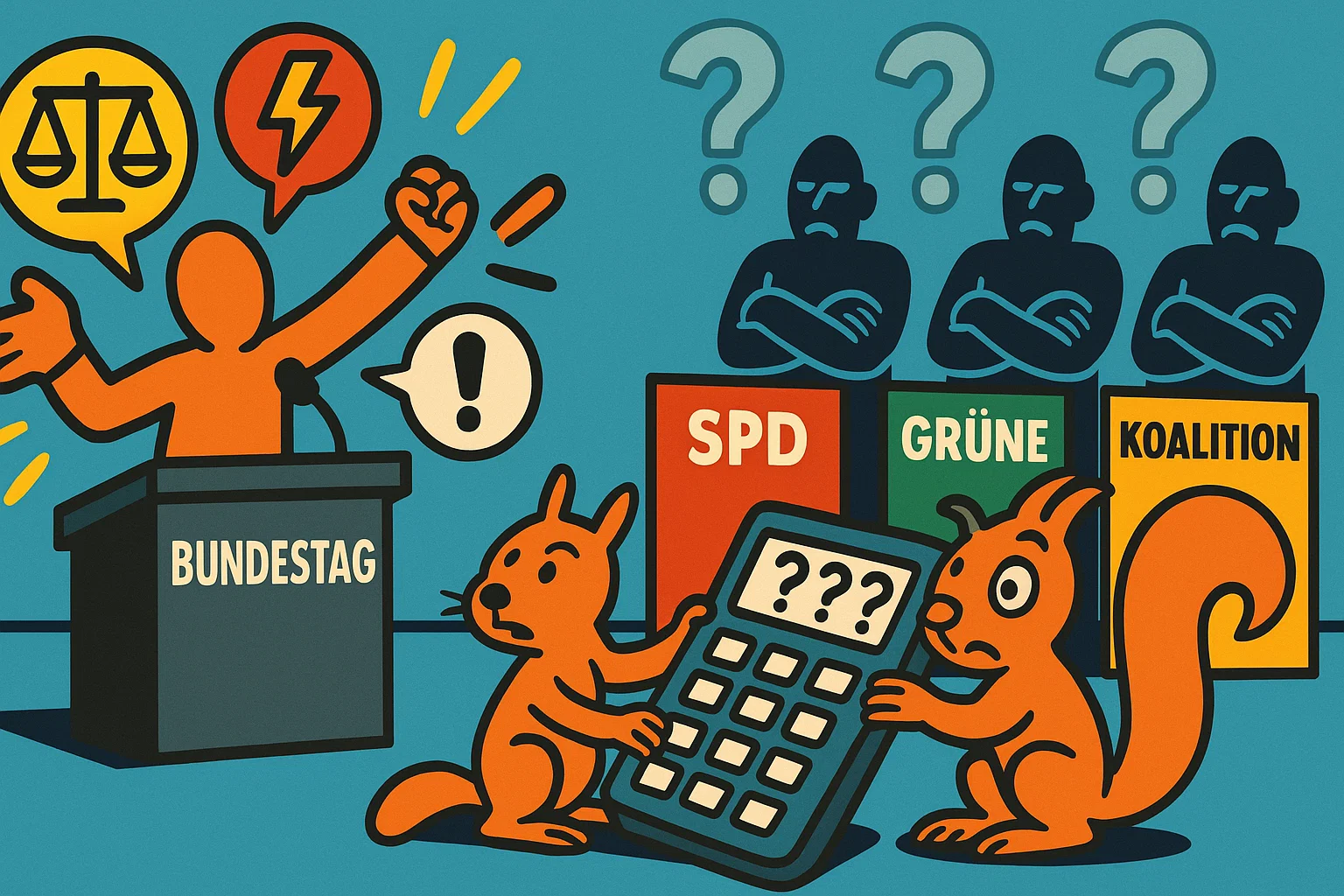
The Bundestag debate as a balancing act: Moral call on the left, coalition pressure on the right. The squirrel with calculator can't compute the logic.
At the heart of the debate lies the fundamental difference between two systems. To understand this gap, we need to examine both systems in detail.
System 1: Statutory Pension Insurance (GRV) – For Everyone Else
Who pays? All employees contribute to a pay-as-you-go system (currently 18.6%). Deducted automatically from your salary every month – half paid by you, half by your employer. Allianz
How is it calculated? Pension amount is based on contributions paid throughout entire working life (so-called "Entgeltpunkte" = earnings points). Current point value is €40.79. Deutsche Rentenversicherung
Maximum Pension Example Calculation: Someone paying maximum contributions (contribution assessment ceiling) for 26 years earns approximately 2.0 pension points per year. Calculation: 26 years × 2.0 points × €40.79 = €2,121.08 gross. Vermögenszentrum
Reality: Average pension is far below this. Average payment amount (actual amount received after social insurance contributions deducted) is approximately €1,100. Sozialpolitik-aktuell
System 2: Parliamentary Pension (Altersentschädigung) – Special System
Who pays? Nobody. MPs contribute nothing to a pension system. Their pensions are directly financed from taxes. Bundestag Lexikon
How is it calculated? The pension is a tax-financed "salary continuation" (like civil servants). Amount is based solely on years of service and final salary, not lifetime performance.
Formula: MPs earn 2.5% of current salary as pension entitlement for each year in Bundestag. Salary was raised to €11,833.47 on July 1, 2025. Surplus
Example Calculation 1 (8 years in Bundestag):
8 years × 2.5% = 20%
20% of €11,833.47 = €2,366.69 per month Abgeordnete-in-GRV
Example Calculation 2 (26 years in Bundestag):
26 years × 2.5% = 65%
65% of €11,833.47 = €7,691.75 per month
Maximum percentage: Maximum pension entitlement is 71.75% of salary.
- After 8 years of work: MPs receive €2,366. An average-earning regular worker receives approx. €509.
- After 26 years (maximum contributions): MPs receive €7,691. A high earner receives €2,121.
- Average pension (after 45 years): €1,100 – below poverty line.
Factor between maximum and average: 7
🌍 International Comparison: This 7× gap is extreme by international standards. UK MPs get roughly 2-3× average pension, US Congress members 2-4× average Social Security. Germany's system stands out for both the multiplier AND the zero-contribution model.
"Danger Recognized, Danger Not Averted" – Vollath's Klingbeil Attack
Perhaps the sharpest moment of the speech came when Vollath confronted the SPD with their own party leader's words. She quoted Lars Klingbeil:
"The Greens also demand this. And I quote the SPD, now Deputy Chancellor: 'Why am I not in the pension system as a politician? I would like to change that. This is a matter of justice.' Very good, Mr. Klingbeil. Danger recognized, danger not averted!" Bundestag Live 01:16:36
The reaction in Parliament was clear: Die Linke applauded, AfD shouted "Exactly!", SPD parliamentary group visibly uncomfortable.
Klingbeil Quote: Verified
Vollath's quote is genuine. Lars Klingbeil said in the ZEIT podcast "Alles Gesagt?" (timestamp 04:36:46):
"Why we as politicians are in a different system is completely incomprehensible to me. I want to be in the statutory pension system. [...] This is a matter of justice." Generationengerechtigkeit
The Bitter Irony: One Day Later
On November 15, 2025 – one day after the debate – Deutschlandfunk reported that Klingbeil "rules out changes to pension package." Deutschlandfunk The SPD blocked Die Linke's proposal together with the Union.
Vollath concluded her speech with a sarcastic aside:
"My crystal ball unfortunately tells me: The SPD will once again sacrifice social justice for coalition peace. This is unfortunately not a coincidence, this is a pattern. We as Die Linke stand for justice not just in interviews, but in every parliamentary debate!" Bundestag Live 01:16:47
Reactions: Who Says What About the Two-Tier System?
Greens: "We Demand It Too" – But Vote Against
Vollath claimed in her speech that the Greens also demand integrating MPs into pension insurance. This statement is documented.
Armin Grau, spokesperson for Labor and Social Policy of the Green parliamentary group, stated on July 17, 2025:
"In addition, other groups such as previously uninsured self-employed persons, parliamentarians and, in perspective, civil servants should also be gradually integrated into statutory pension insurance." Greens Bundestag
On November 14, 2025, the Greens blocked proposal 21/2708 – exactly the proposal that would implement this demand.
CDU/CSU: "Constitution Protects Independence"
The CDU/CSU explicitly defended the special system. Ansgar Heveling (CDU) argued with the "special constitutional status of the parliamentary mandate" and the necessity of "remuneration that secures independence" according to Article 48 of the Constitution. Plenarprotokoll
CDU Argument Simplified: The CDU says MPs must be financially "independent" from worries, hence need high pensions. But the counter-argument: Why is €7,700 necessary for "independence," but €1,100 sufficient for regular pensioners?
AfD: "We've Been Demanding the Same Since 2025"
AfD's applause for Sarah Vollath was no coincidence. The AfD parliamentary group submitted its own proposal on July 22, 2025 (21/958): "Reform der Politikerpensionen – Bundestagsabgeordnete in die gesetzliche Rentenversicherung aufnehmen" (Reform of politician pensions – integrate Bundestag members into statutory pension insurance). AfD Proposal 21/958
This is one of the rare content overlaps between Die Linke and AfD on a fundamental social policy question.
Warning – AfD Strategy: AfD agreeing with Die Linke on this doesn't mean both parties share the same goals. AfD uses this populistically: "Politicians serve themselves!" message. Die Linke genuinely critiques systemic inequality. For international readers: AfD is a far-right, anti-immigration party – fundamentally different from Die Linke's democratic socialism.
Conclusion: What Happens Now?
Proposal 21/2708 was referred to expert committees. There it will likely be rejected by the coalition majority. However, the debate has exposed the programmatic contradictions of SPD and Greens.
Because the debate took place on Friday afternoon, it has so far received limited media coverage. Public pressure could increase for coalition parties to explain their stance on the "two-tier system."
This debate matters beyond Germany because it reveals a fundamental tension in representative democracy:
- Symbolic: MPs after 8 years get €2,300, workers after 45 years get €1,100 – this gap undermines democratic legitimacy
- Political: SPD claims to be "the party of justice" but blocks pension equality – classic political hypocrisy
- Practical: If Die Linke's proposal passed, MPs would join the regular system – a powerful equality signal similar to how UK/US systems work
Die Linke's message: "Equality – from MPs to pensioners." This resonates especially in a country where pensioners collect bottles while parliamentarians secure €7,700 monthly pensions without contributing a cent.