Germany's New Migration Policy: What's Changing Now

Want more details? 📖 Click here for the full version with all background information.
Cover illustration: One arrow labeled "Skilled Workers" points to Germany; another arrow is stopped at an EU border ("Border Procedures").
What Happened
The German government (CDU and SPD parties) passed new immigration rules. German Government The goal is to better control who comes to Germany and who doesn't.
The Most Important Points
- Fewer people without valid asylum reasons should come
- More skilled workers (like craftspeople, nurses) should be specifically recruited DLA Piper
- Border checks at EU external borders will be stricter
- Some people can no longer bring their families
What Changes Specifically?
1. Families
People with only "subsidiary protection" cannot bring their family for two years. German Government
What does this mean? "Subsidiary protection" is a lower form of protection than "refugee status". People with this status cannot bring spouses or children to Germany until July 2027.
💡 Important to Know: Family Reunification in Context
This is NOT about EU citizens or regular immigrants! If you're from another country living in Germany with a work visa or residence permit, this doesn't affect you. You can still bring your family.
Who IS affected? Only people who fled war or persecution and got "subsidiary protection" instead of full refugee status. This is often people from countries with civil war—but not everyone qualifies as a "full refugee" under international law.
Real example: Imagine someone from a war zone. They're safe enough not to be sent back, but they don't meet the strict legal definition of "refugee". These people now have to wait 2 more years before bringing family.
Why is Germany doing this? The government says it's to reduce the total number of asylum-related arrivals. Critics say it's inhumane to separate families for years.
2. Admission Programs
Voluntary humanitarian programs – for example for particularly vulnerable people from Afghanistan – are being stopped. German Government
What were these programs? Germany had special programs where NGOs and communities could sponsor refugees from crisis countries. These are now ending—only regular asylum applications remain.
3. EU Rules (GEAS)
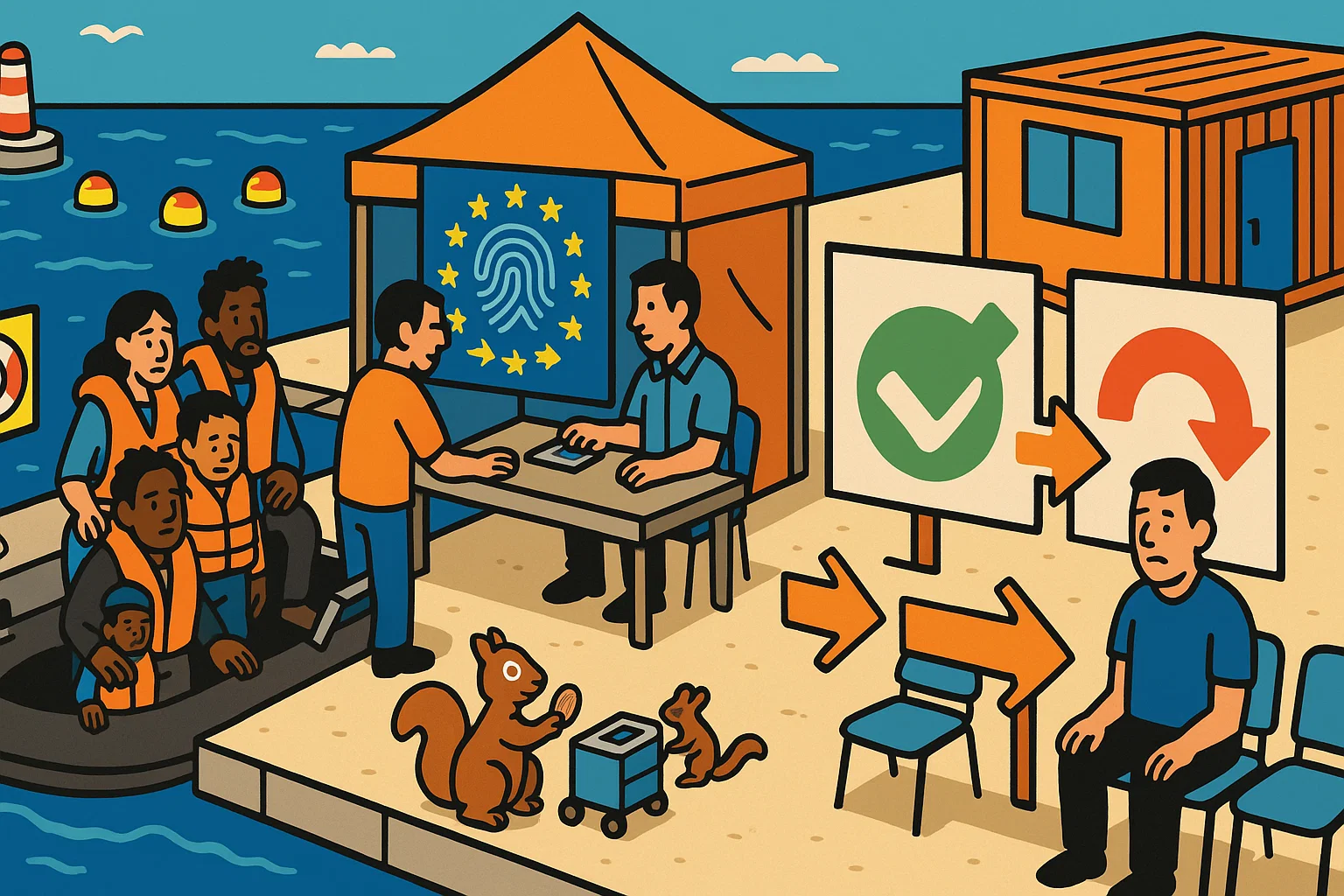
Germany now implements the new EU asylum system. BMI This means: Stricter controls and faster decisions directly at EU external borders.
What happens there? Instead of people coming to Germany first and applying for asylum here, this will happen at the EU's outer borders in the future. There it will be checked who may enter.
🌍 What Is GEAS? A Simple Explanation
GEAS stands for: "Common European Asylum System" – it's a set of EU-wide rules for how asylum works.
Old system: You could enter any EU country (like Greece, Italy, or Germany) and apply for asylum there. Different countries had different rules and processing times.
New system (GEAS):
- Border procedures: Many asylum applications are now processed AT the EU external border before you even enter
- Fingerprint database (EURODAC): Everyone's fingerprints are taken—even children as young as 6 years old
- Faster decisions: Applications should be decided within weeks, not months
- Distribution: EU countries share responsibility for refugees (though this is controversial)
Practical example: If you arrive at the Greek-Turkish border seeking asylum, you might wait in a border facility while your application is processed—instead of traveling through Europe to Germany first.
Why the controversy? Human rights groups worry about conditions at border camps. Some EU countries refuse to participate. Germany is now implementing it despite these concerns.
4. Right to Stay ("Bleiberecht")
People who are "well integrated" and have been living in Germany for a long time with only "tolerated" status get a new chance for permanent residence. Migrando
What does "well integrated" mean? For example: You have a job, speak German, and have been living here for several years. Then you can now more easily get a regular residence permit.
✅ Good News for Long-Term Residents: What "Bleiberecht" Means
This is actually GOOD news! It helps people who have been stuck in limbo for years.
Who benefits?
- People whose asylum was rejected BUT they can't be sent home (maybe their home country won't take them back)
- They've been living here for years with "Duldung" (toleration)—not allowed to stay, but can't be deported
- They learned German, got a job, pay taxes, their kids go to German schools
- But they live in constant uncertainty—renewing "Duldung" every few months
What changes now? If you meet certain criteria (job, language, years in Germany, clean record), you can get a real residence permit—not just "toleration".
Real scenario: Imagine a family from West Africa. Asylum rejected in 2018. Can't be deported because their country doesn't cooperate. Parents work in care/construction, kids speak perfect German, everyone pays taxes. Before: endless uncertainty. Now: pathway to permanent legal status.
Why is Germany doing this? Pragmatic thinking: These people are already here, already contributing to society. Why not give them legal certainty instead of wasting resources on impossible deportations?
5. Skilled Workers
People with in-demand professions – like nurses, electricians, or IT specialists – should be able to come to Germany more easily. DLA Piper
🔧 Skilled Workers: Germany's Labor Shortage Problem
Germany has a HUGE problem: Not enough workers! Especially in healthcare, crafts, IT, engineering.
The numbers:
- Germany needs about 400,000 skilled workers per year
- Population is aging—more retirees, fewer young workers
- Many sectors literally cannot find enough staff
What's changing for skilled workers?
- Faster visas: Streamlined application process for qualified professionals
- Recognition of foreign degrees: Easier to get your diploma/certification recognized
- Blue Card expansion: EU's skilled worker visa becomes more accessible
- Company sponsorship: Employers can more easily bring workers from abroad
- Lower salary thresholds: You don't need as high a salary to qualify
Real examples of who benefits:
- Indian software engineer: Can get visa faster, bring family immediately
- Filipino nurse: Hospital can sponsor, credentials recognized quicker
- Brazilian electrician: Apprenticeship pathway, German language course support
- Egyptian doctor: Faster licensing process, integration support
The catch: You need provable qualifications. This isn't for everyone—only people with degrees, certifications, or demonstrable professional skills.
Why the double standard? Germany says: "We want to control WHO comes. We need workers, not irregular migration." Critics call it hypocritical—closing doors to refugees while opening them to profitable workers.

Illustration: An EU external border with symbolic border procedures. In the background a digital database (EURODAC), in the foreground people in a waiting tent during registration.
Why Are There Two Different Directions?
The government is trying to solve two problems at once:
- Problem 1: The CDU wants to limit irregular immigration, as promised during the election campaign. CDU
- Problem 2: The SPD (and German businesses) want to create legal pathways for skilled workers who are urgently needed.
The solution: Do both at the same time – fewer people without valid asylum reasons, more people with in-demand skills.
What Do Other Parties Say?
Opposition parties criticize the plans – but for very different reasons:
The Greens and The Left say: The measures are too harsh. They criticize the suspension of family reunification as inhumane. Das Parlament
The AfD says: The measures are not harsh enough. They demand to completely stop migration.
⚖️ Understanding the Political Divide
This policy reveals Germany's deep political split on migration:
The Left/Greens position:
- Migration is a human right—people fleeing war deserve protection
- Separating families is cruel and violates human rights
- Border procedures create inhumane detention camps
- Germany has a historical responsibility (after WWII) to help refugees
- Integration works—most refugees contribute to society
The CDU/Conservative position:
- Migration must be controlled—unlimited asylum is unsustainable
- Many asylum seekers aren't "real refugees"—they're economic migrants
- Local communities (cities, towns) are overwhelmed
- Voters demand action—ignoring this helps right-wing extremists
- We can help refugees AND control borders—it's not either/or
The AfD/Far-Right position:
- Almost all migration should stop—Germany for Germans
- Islam and German culture are incompatible
- Refugees are a security threat and economic burden
- Close all borders, deport everyone without legal status
- This CDU/SPD policy is just window dressing—nothing really changes
Where does the truth lie? Probably somewhere in between. Germany struggles to balance humanitarian values with practical limitations. This policy tries to find a middle ground—but satisfies nobody completely.
Why Does This Matter?
The new rules show how CDU and SPD work together. The CDU gets what it promised: stricter controls. The SPD gets approval for its other plans in return – for example on hospitals.
Whether the rules pass through the Bundestag (parliament) is still uncertain. The votes will be close. Bundestag
📊 Quick Reality Check: Migration Numbers in Context
Let's look at actual numbers to understand what's really happening:
Asylum applications in Germany:
- 2015 (peak): 890,000 applications (Syrian war refugee crisis)
- 2022: 244,000 applications
- 2024: 351,000 applications
- 2025 (Jan-Sep): Already declining—down 46.5% for Syrian nationals
Where do asylum seekers come from?
- Syria: Still #1, but decreasing (war de-escalating in some regions)
- Afghanistan: #2 (Taliban takeover in 2021)
- Turkey: #3 (political persecution)
- Iraq, Eritrea, Somalia: Also significant numbers
Recognition rates (who gets asylum?):
- Syrians: ~70-80% get protection (war refugees)
- Afghans: ~50-60% (depends on region/case)
- West Africans: ~10-20% (mostly economic migrants, not persecution)
- Western Balkans: ~5% (EU considers them "safe countries")
What this means: Germany already rejects many applications. The new policy makes it even stricter. Critics ask: Are we turning away people who genuinely need help? Supporters say: We're preventing abuse of the asylum system.
What Happens Next?
Timeline:
- Now (November 2025): Laws are being debated in parliament
- Coming weeks: Bundestag vote (expected to be very close)
- If passed: Implementation starts in early 2026
- Family reunification suspension: Ends July 23, 2027 (2-year period)
- GEAS border procedures: Gradual rollout across 2026-2027
What to watch:
- Will the coalition hold together? Some SPD/CDU members might vote against
- Legal challenges expected—especially on family reunification
- How will this affect Germany's reputation internationally?
- Will the skilled worker programs actually work, or will bureaucracy slow them down?