Migration Pact Passed: The Grand Coalition's Dual Strategy Between Restriction and Labor Shortage

Too complex? 💡 Click here for the simplified version.
Cover illustration: A document representing the coalition agreement rests on a foundation of EU stars. The document bears two different stamps: one symbolizing "Stop" (restriction), the other "Welcome" (skilled workers).
On November 12, 2025, Germany's federal government finalized a comprehensive legislative package to control and limit migration. The package combines significant tightening of asylum law with new incentives for skilled worker immigration. It is the core promise CDU Chancellor Friedrich Merz made during his campaign—and the price the SPD pays for its social policy goals.
Key Takeaways
- GEAS Implementation: The federal government will initiate the national implementation of the Common European Asylum System (GEAS), which includes stricter border procedures.
- Family Reunification Suspended: Family reunification for subsidiarily protected persons is suspended for two years until July 23, 2027. Federal Government
- Resettlement Programs Ended: Voluntary federal resettlement programs, such as those for Afghanistan, are being terminated. Federal Government
- Western Balkans Cap: Immigration under the Western Balkans regulation is capped at 25,000 people per year. Federal Government
- Skilled Worker Promotion: In parallel, a new residence permit for well-integrated tolerated persons is being created and skilled worker immigration is being specifically promoted. Migrando · DLA Piper
Background: From Campaign to Coalition Agreement
Today's finalized package is the direct implementation of core points already set out in the coalition agreement of April 2025 and the exploratory paper of March 2025. Migrando · Fragomen
The CDU/CSU campaigned in 2025 under the clear demand "We're ending illegal migration." CDU · CDU Even before the election, then-opposition leader Merz and then-Chancellor Scholz engaged in fierce battles over migration control. Das Parlament
The current coalition agreement represents a double strike: it aims to limit irregular migration while simultaneously promoting legal migration of skilled workers.
🌍 Why This Matters for English-Speaking Countries
Germany's migration reform mirrors debates across the Anglo-American world—from the US-Mexico border crisis to UK's Rwanda plan and Australia's offshore processing. But there's a critical difference: Germany is attempting to simultaneously restrict irregular migration while actively recruiting skilled workers.
📍 Regional Comparisons:
🇺🇸 United States:
- Title 42 expulsions: Like Germany's GEAS border procedures, the US used Title 42 (now ended) to rapidly expel asylum seekers at the border without full hearings
- Family separation policy (2018): Germany's family reunification suspension echoes controversial US policies that separated families at the southern border—though Germany's applies to a narrower category (subsidiary protection holders)
- H-1B visa program: Unlike Germany's dual approach, the US has long separated skilled worker immigration (H-1B) from humanitarian asylum—Germany is now attempting both simultaneously
🇬🇧 United Kingdom:
- Rwanda deportation plan: The UK's controversial plan to send asylum seekers to Rwanda for processing parallels Germany's GEAS strategy of externalizing asylum procedures to EU borders
- Post-Brexit points system: The UK shifted from EU free movement to a points-based skilled worker system—Germany is maintaining EU freedom of movement while adding skilled worker pathways from outside the EU
- Channel crossings crisis: Like Germany with Mediterranean arrivals, the UK struggles with irregular Channel crossings—both countries are tightening procedures while facing labor shortages
🇨🇦 Canada:
- Express Entry system: Canada's highly selective skilled worker program serves as a model—Germany's Fachkräfteförderung aims to replicate this success
- Safe Third Country Agreement: Canada's agreement with the US to return asylum seekers parallels Germany's Dublin regulation within the EU
- Temporary resident cap (2024): Canada recently capped temporary residents at 5% of population—Germany's Western Balkans cap (25,000/year) follows similar logic
🇦🇺 Australia:
- Offshore processing (Nauru, Manus Island): Australia's "Pacific Solution" of processing asylum seekers offshore directly inspired the EU's GEAS border procedures that Germany is now implementing
- Operation Sovereign Borders: Australia's military-led border operation represents the most extreme version of what Germany's coalition calls "Begrenzung" (limitation)
- Skilled migration priority: Australia has long prioritized skilled workers over humanitarian entries—Germany is now adopting this dual-track model
What does "subsidiarily protected" mean?
Subsidiary protection is a form of protection below the Geneva Refugee Convention. Those granted subsidiary protection are not recognized refugees in the strict sense, but have demonstrated that they face serious harm in their country of origin—such as torture, inhuman treatment, or serious individual threat due to arbitrary violence in the context of armed conflict.
Subsidiary protection grants a residence permit, but with more limited rights than refugee recognition—for example, regarding family reunification, which is now suspended for two years.
The Measures in Detail: Restriction and Promotion
The restriction measures are politically the most significant interventions. The suspension of family reunification for subsidiarily protected persons and the termination of voluntary resettlement programs are intended to reduce immigration numbers. Federal Government · Migrando
📊 Context: Germany's Immigration Numbers in International Comparison
To understand why Germany is tightening asylum policy, it's crucial to see the numbers in context:
Germany's 2024 asylum applications: ~351,000
Population: 84 million → 4.2 asylum claims per 1,000 residents
Comparative rates (2024 estimates):
- Austria: ~6.8 per 1,000 (highest in EU per capita)
- Sweden: ~5.2 per 1,000
- Germany: ~4.2 per 1,000
- United States: ~3.8 per 1,000 (southern border encounters; many expelled under Title 42/Title 8)
- United Kingdom: ~1.2 per 1,000
- Canada: ~0.6 per 1,000 (but accepts 500,000+ economic immigrants annually)
- Australia: ~0.1 per 1,000 (offshore processing keeps onshore claims very low)
Key insight: Germany faces mid-range asylum pressure compared to other wealthy democracies. The Syrian conflict peak (2015-2016: 890,000 arrivals in Germany alone) traumatized German politics and explains current restrictive mood—even though current numbers are far lower.
The political paradox: In January-September 2025, Syrian arrivals to Germany already declined 46.5% compared to 2024. Destatis Yet the government is implementing new restrictions—suggesting this is more about political signaling than responding to current crisis.
This political decision is contextualized by recent Federal Office statistics: From January to September 2025, a decline in immigration compared to the previous year was already reported—for Syrian nationals, for example, by 46.5 percent. Destatis

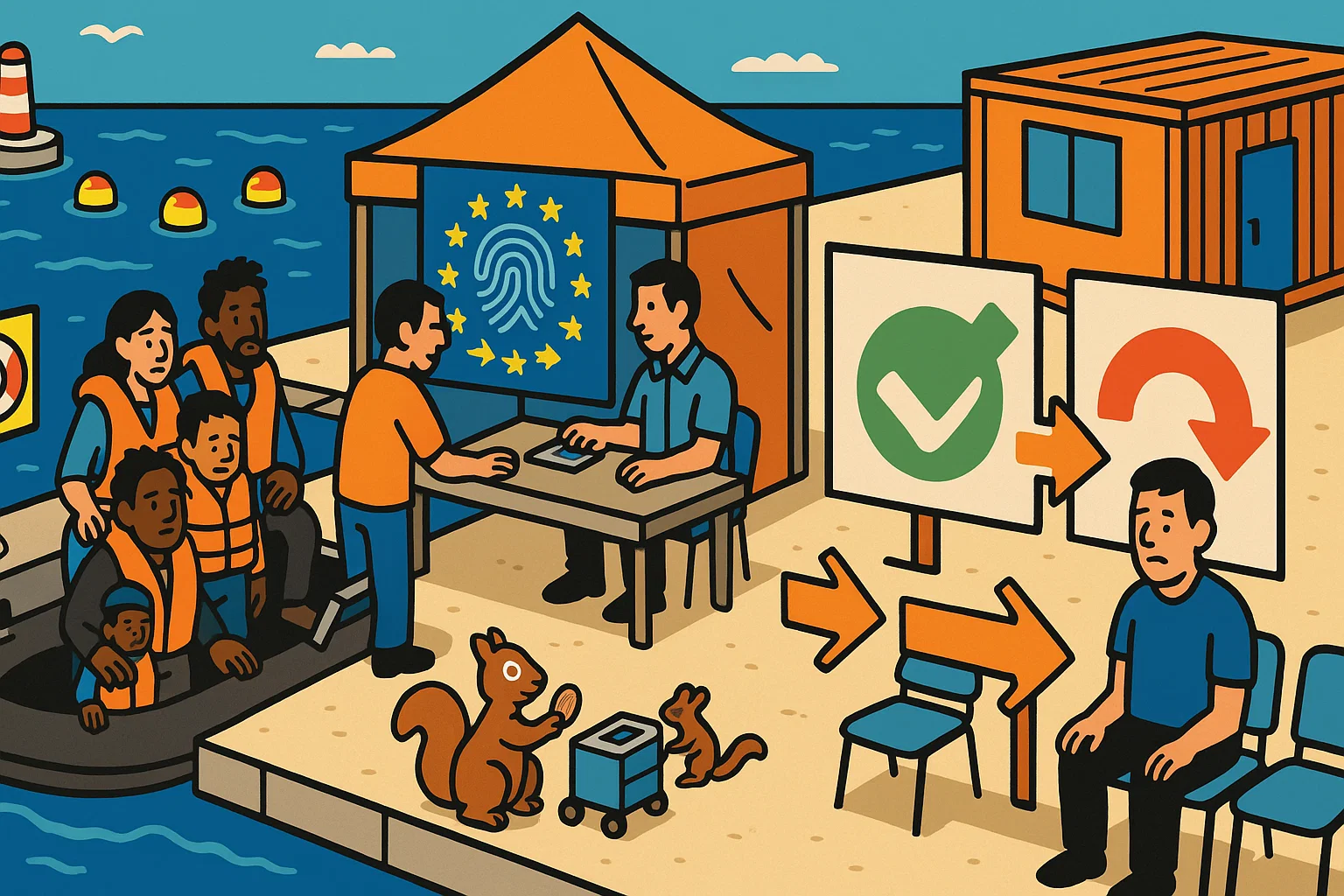
Illustration: An EU external border with symbolic border procedures. In the background, a digital database (EURODAC); in the foreground, people in a waiting tent during registration.
GEAS: The Europeanization of Asylum Policy
Parallel to national tightening, the government is driving forward the national implementation of the Common European Asylum System (GEAS). With this, the federal government is outsourcing politically sensitive aspects—such as border asylum procedures and distribution—to the European level.
🔍 GEAS Explained for Non-EU Readers
The Common European Asylum System (GEAS) is the EU's attempt to create a unified asylum policy across 27 member states. Think of it as the EU's version of trying to harmonize immigration policy across 27 different "states"—except these states are sovereign nations with their own languages, histories, and political systems.
Core components:
- Border procedures: Asylum claims processed at EU external borders (Greece, Italy, Spain, Poland) before entry—similar to US "Remain in Mexico" policy
- EURODAC database: EU-wide biometric fingerprint database of all asylum seekers from age 6—comparable to US-VISIT or UK's biometric residence permits
- Dublin regulation: First EU country of entry is responsible for asylum claim—often criticized as unfair to southern/eastern border states
- Solidarity mechanism: Mandatory relocation of asylum seekers from border states to other EU countries—highly controversial, resisted by Poland, Hungary
Why it's controversial: Southern EU states (Greece, Italy) complain they're overwhelmed by arrivals. Northern states (Germany, Sweden) fear they'll become destinations for relocated migrants. Eastern states (Poland, Hungary) refuse to participate at all. It's the EU's most divisive policy issue.
The national implementation plan reveals the enormous administrative complexity of this Europeanization: This includes lowering the minimum age for the EURODAC database (biometric data from age six), adapting the Central Register of Foreigners, and extensive new data maintenance obligations. BMI National Implementation Plan (PDF)
This binds massive administrative capacities and shifts the political conflict from the federal-state level to the EU's external borders. The implementation of GEAS and the EURODAC regulation massively affects state administrations administratively and financially. taz
Analysis: The Price of the Grand Coalition
At first glance, the presented measures seem contradictory: On one hand, migration is being limited; on the other, it's being promoted. However, analysis of the coalition agreement reveals that this is not a contradiction but the exact price for forming this Grand Coalition.
🎭 Understanding Coalition Politics for Anglo-American Readers
Why does Germany need a "Grand Coalition"? Unlike the US/UK's two-party winner-takes-all systems, Germany uses proportional representation. This means no single party has governed alone since 1961—coalitions are mandatory.
The 2025 election result:
- CDU/CSU (conservatives): 28.5% → largest party, but far from majority
- AfD (far-right): 20.8% → second-largest, but all parties refuse to work with them ("cordon sanitaire")
- SPD (social democrats): 16.4%
- Greens: 11.6%
- Left: 8.8%
- FDP (liberals): 4.3% → below 5% threshold, out of parliament
Coalition mathematics: CDU needed 50%+ to govern. Options:
- "Jamaica" (CDU + Greens + FDP): Impossible—FDP didn't make it into parliament
- "Kenya" (CDU + SPD + Greens): Greens refused, fearing blame for austerity
- "Grand Coalition" (CDU + SPD): Only remaining option = 44.9% combined → no majority!
The problem: Even CDU + SPD together fall short of 50%. They need either (a) tolerance from another party (risky), or (b) defectors from other parties (happened in this case—some Green MPs crossed over).
Why this matters for migration policy: The CDU got migration restrictions (their key demand). The SPD got skilled worker pathways and social spending (their key demand). Neither party got what they actually wanted—both got just enough to claim victory to their voters. This is the "price" the article refers to.
Contrast with Anglo-American systems:
- US: President Biden doesn't need to coalition with Republicans—he just signs executive orders (which Trump then reverses)
- UK: Starmer's Labour has absolute majority → can pass anything without negotiation
- Canada: Trudeau governs as minority, but can pass legislation issue-by-issue with different parties
- Germany: Merz's CDU must negotiate every single policy with SPD partners or government collapses
The CDU under Chancellor Merz receives central migration and restriction policy elements from its campaign. In return, the SPD gets support for social policy projects—such as the hospital package—and the skilled worker component remains intact. DLA Piper The agreement functions as the government's central labor and migration policy coordination element.
| Measure | Detail (Facts) | Political Goal |
|---|---|---|
| PILLAR 1: RESTRICTION & CONTROL | ||
| Family Reunification | Suspended for 2 years (subsidiarily protected) | (CDU demand) Reduce pull factors and relieve municipalities |
| Resettlement Programs | Termination of voluntary programs | (CDU demand) Signal control instead of humanitarian admission |
| GEAS Implementation | Introduction of EU border procedures, EURODAC expansion | (Joint) Europeanization of responsibility, relocation of procedures to external borders |
| PILLAR 2: SKILLED WORKERS & INTEGRATION | ||
| Skilled Worker Immigration | Targeted promotion and incentives | (SPD/Business demand) Secure labor base, strengthen legal pathways |
| Tolerated Persons | New residence permit for well-integrated | (SPD demand) Humanitarian aspect and track change for those already present |
Opposition Reactions: Fundamental Contradictions
The opposition in the Bundestag rejects the package for fundamentally different reasons.
Alliance 90/The Greens and The Left criticize the measures as "isolation" and inhumane. Das Parlament · Die Linke BT
Both parties argue that suspending family reunification violates humanitarian principles and that border procedures at EU external borders would de facto create camps. They demand safe and legal escape routes as well as solidarity-based European distribution.
Analysis: The Left and Greens attack the government from a humanitarian perspective—they see the reform as an abandonment of European values and fear a worsening of the humanitarian situation at external borders.
The AfD parliamentary group, however, rejects the package as insufficient and insists on its demand to completely stop "mass migration."
The AfD demands a complete admission stop, border closures, and the return of all persons without asylum entitlement. The party rejects the GEAS system because it restricts national sovereignty and offers no effective control.
Analysis: The AfD uses the migration issue for fundamental criticism of the entire European system—for them, the reform is just another proof of the established parties' failure.
Outlook: Narrow Majority and Legal Challenge Expected
The legislative package must now pass the Bundestag. A recent roll-call vote on a resolution showed a narrow majority of 348 yes to 344 no votes for the coalition, suggesting potential defectors. Bundestag
It is expected that the measures—particularly the suspension of family reunification—will be legally challenged. However, the greatest political resistance is expected from the Bundesrat, as the implementation of GEAS and the EURODAC regulation massively affects state administrations administratively and financially.
The coming weeks will show whether the Grand Coalition can get its central domestic policy pact through parliament—and whether the dual strategy of restriction and promotion works in practice.
📦 Source Archive from November 12, 2025
All external sources linked in this article have been permanently archived via the Internet Archive:
- Article "Bundestag rejects motion to improve..." (Internet Archive)
- Article "Federal government plans extensive changes..." (Internet Archive)
- Article "Migration and skilled worker immigration package" (Internet Archive)
- Press release "Agreement on migration policy measures" (Internet Archive)
If external sources are no longer available, you can access the archived version from November 12, 2025 via these archive links.